
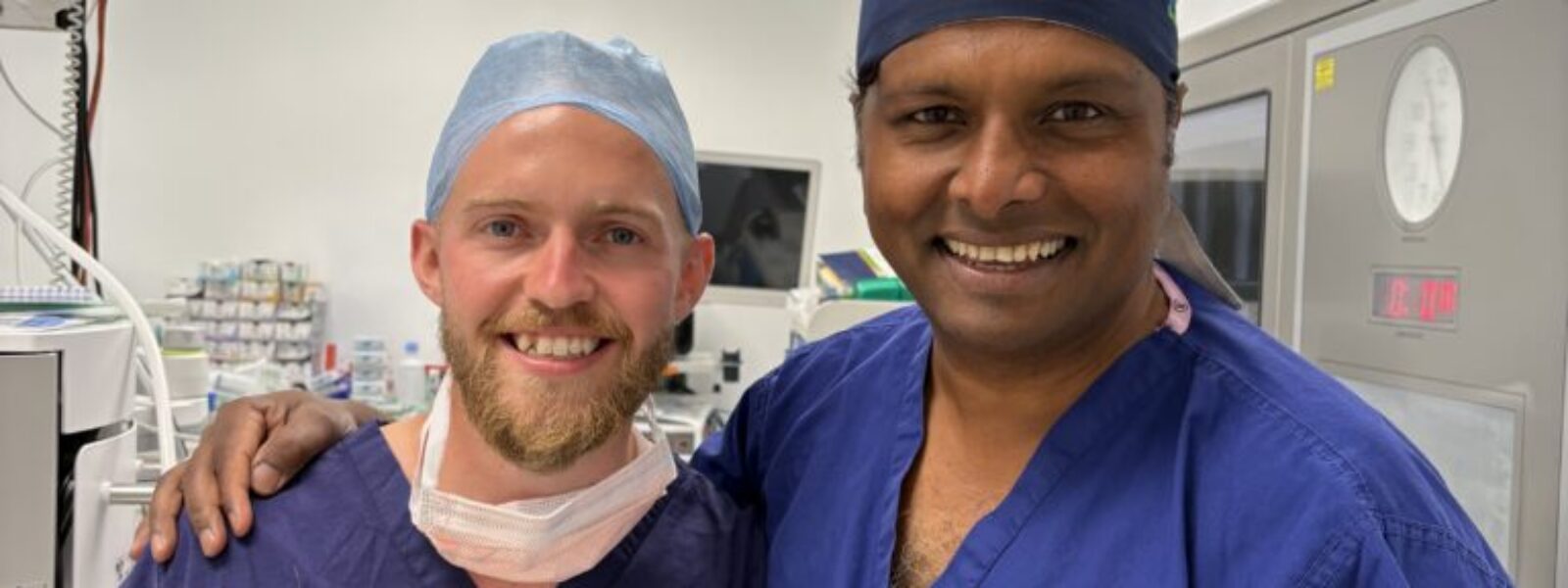
True to my promise to build relationships with the best surgeons this country has to offer, I spent yesterday morning in theatre with Sam Rajaratnam and his team at Cleveland Clinic London. Needless to say, I found it to be an enlightening and thoroughly enjoyable morning — the kind of CPD you don’t get from a course.
In theatre: an ACL reconstruction and a TKR back to back
Watching an ACL reconstruction and a total knee replacement in the same session is a good reminder of how wide the knee surgery spectrum really is. The ACL case was actually a revision — the patient’s original reconstruction had failed (done by another surgeon), and they’d come to Sam to have it reconstructed via a hamstring tendon graft. Repairing rather than reconstructing is appealing in principle, since it preserves the patient’s own tissue and proprioceptive fibres instead of replacing them with a graft. But the evidence doesn’t really support it as a default option — one meta-analysis of contemporary trials found revision rates of 11.4% after repair versus 5.8% after reconstruction, roughly double the risk, and that gap widens considerably in younger, more active patients, where repair has been linked to as much as a six-fold increase in revision risk under the age of 21. Sam was clear on where that leaves most patients: repair is rarely the best direction, however tempting it looks on paper.
On the TKR front, seeing the knee itself before Sam began the replacement was, if anything, more instructive than any paper I have read. The posterior lateral condyle was worn back close to bone, with clear, established osteophyte formation along the joint line — the kind of change that is now clear to see – no amount of manual therapy, exercise, or “lubrication” was ever going to reverse. It’s a useful check on a bias I think most physios carry to some degree: that with enough load management and time, most knees can be coaxed back towards function. Some can. This one couldn’t have been — and once a joint has drifted into a valgus alignment, loading the lateral compartment more than it was built for, as this one had, you’re managing symptoms around a joint that’s already changed shape, not correcting a reversible process. It reframed a few of my own assumptions about where the ceiling actually sits for conservative management.
What stood out beyond the technical decision-making was the coordination in the room itself. Every handover, instrument pass, and position change happened without anyone needing to ask. That kind of rhythm doesn’t happen by accident; it’s what a team looks like once they’ve clearly put in the reps together. Not only that, I sat with Sam as he called his patients’ loved ones following procedure to let them know how it went (cognisant of the anxiety they were likely carrying), following which he did the same for each patient via a voice note, for them to listen to once they come around from the anaesthetic. It’s a bedside manner and personability I have not witnessed anywhere else.
On injectables
One conversation worth sharing on its own: Sam is sceptical about the routine use of injectables — corticosteroid and hyaluronic acid — for knee osteoarthritis, a position that sits closely with where the evidence, and my own practice, already are. Both can offer genuine short-term relief by damping down the inflammatory cascade driving the pain, but neither does much to influence the disease itself. NICE’s 2022 osteoarthritis guideline now recommends against hyaluronan injections outright, citing inconsistent benefit. Corticosteroids fare a little better for short-term symptom control, but a well-known two-year randomised trial in JAMA found no significant difference in pain versus saline, alongside significantly greater cartilage volume loss in the steroid group. None of that makes injections useless — they can buy a genuinely uncomfortable knee some breathing room — but they’re a symptom management tool, not a way of changing the trajectory of a joint that’s already begun to fail.
Rethinking what happens after: are we overdoing early rehab?
The conversation that stuck with me most was around the role of therapy in the first few weeks after a TKR. There’s a real temptation in physio — mine included, at times — to chase range of motion and strength hard from day one, as if more input always means faster recovery. Sam’s view, and one I’m increasingly persuaded by, is that a lot of early “rehab” is actually just feeding the body’s inflammatory response, and that the priority in that first window is pain control, swelling management, and protecting the joint while it settles — not maximal loading. As he put it, in those early weeks it’s about the hinge, not the muscles: get the joint itself moving well, tracking well, and settling into its new mechanics, and the strength will follow once there’s a joint worth loading. Getting someone moving safely and confidently matters far more in the first few weeks than getting their flexion to 130 degrees or “quads developed”.
The numbers behind the confidence
It’s easy to say a surgeon is “the best” — Sam showed me the report that actually backs it up. His National Joint Registration Consultant Level Report covers 3,832 linkable primary knee procedures over the last ten years, and across five consecutive annual audits (March 2021 through March 2025) his Standardised Revision Ratio has sat consistently below 1 — meaning fewer of his patients have needed a revision than would statistically be expected for his volume and case mix. That result is low enough to be significant at the 99.8% confidence interval, which in plain terms means it isn’t a good run or a small sample skewing the picture — it’s a decade of consistent outperformance, placing Sam and his team amongst the lowest revision rates of any knee surgeon on the National Joint Registry, the body that independently tracks every hip, knee, shoulder, elbow and ankle replacement performed in the UK. Patients can look up any surgeon’s own results the same way, via the NJR’s surgeon and hospital outcomes tool.
Why early analgesia matters more than we give it credit for
A conversation with Barry Phillips, Consultant in Anaesthesia, reinforced something I don’t think physios talk about enough: how much a well-managed first 24–72 hours of pain relief shapes everything that follows. Get analgesia right early, and patients mobilise sooner, sleep better, and are far less likely to develop the guarding and fear-avoidance patterns that slow the whole rehab process down. It’s a reminder that good outcomes start well before a physio is even in the picture.
A small imaging detail that’s easy to miss
One technical point worth passing on to other clinicians: a standard weight-bearing AP knee X-ray can miss early osteoarthritic changes that only show up on a Rosenberg view — a weight-bearing film taken with the knee flexed to around 45 degrees. That extra angle exposes the back of the joint, where cartilage loss and joint space narrowing typically start, well before it’s visible on a standard AP. If a patient’s knee X-ray looks “clean” but the clinical picture doesn’t add up, it’s worth asking whether a Rosenberg view was ever taken. Sam elaborates on this substantially, having demonstrated that many of his patients have full joint cartilage mapping done via MRI.
Confidence In Referring Knees’ in Need
Spending a morning in theatre doesn’t just build confidence in a surgeon’s hands — it builds confidence in how a whole team thinks about their patients, from the initial consultation, pre-op preparation, and anaesthetic considerations; to what happens in the six weeks after discharge. Having seen it firsthand, Sam and his team are, in my view, amongst the best in their field. I will have no hesitation in recommending my patients who need an orthopaedic opinion on their knee.
Key takeaways
- For most patients — especially anyone hoping to return to sport — ACL reconstruction vs repair is a very nuanced decision and not clear-cut; current evidence shows revision rates run roughly double with reconstruction, and considerably higher again in younger patients.
- Not every worn knee is recoverable through conservative management alone.
- Corticosteroid and hyaluronic acid injections offer short-term symptomatic relief at best — NICE now recommends against hyaluronan for this reason, and trial evidence shows steroids don’t alter the underlying disease course.
- Early rehab after a TKR should prioritise the joint itself over the muscles around it — protecting the knee while it settles matters more in week one than chasing range of motion or strength.
- A well-managed first 24–72 hours of analgesia shapes the whole recovery.
- A standard AP knee X-ray can miss early osteoarthritic changes that a Rosenberg view will catch — worth asking for if the imaging looks “clean”, but the clinical picture doesn’t.
- Take a look at your consultant’s track record via the National Joint Registry before committing to a surgical procedure